In this guide, we will explore the biblical descriptions of angels, cherubim, seraphim, living creatures, and the mysterious wheels associated with Ezekiel’s visions. We will also look at archangels, named angels, guardian angels, fallen angels, Satan, angelic appearances, wings, eyes, and the difference between biblical descriptions and later artistic traditions.
Quick Answer: What Do Biblically Accurate Angels Look Like?
There is no single appearance that describes every angel in the Bible. Some angels appear as human-like messengers, while other heavenly beings described in Scripture have unusual features such as multiple wings, several faces, fiery imagery, or eyes covering their bodies.
The Bible does not present one universal “angel design.” Instead, different passages describe different heavenly beings and different kinds of appearances.
What Are Biblically Accurate Angels?

The phrase biblically accurate angels is a modern expression used to describe angels and heavenly beings based on their descriptions in the Bible rather than on traditional artwork.
It is important, however, to understand that the Bible does not provide one complete visual catalog called “biblically accurate angels.” Scripture contains different accounts involving angels, cherubim, seraphim, living creatures, and other heavenly beings.
The English word angel is connected with words meaning messenger. In the Bible, angels frequently serve as messengers or agents of God. They communicate with people, deliver announcements, provide warnings, carry out divine instructions, and appear in visions.
Some appearances are surprisingly ordinary. In several biblical stories, angels are described as men or appear to people in human form. Other passages, particularly prophetic visions, describe heavenly creatures that are far removed from the familiar human figure with two wings.
This difference is one of the most important things to understand when studying biblical angels.
Why Do People Search for Biblically Accurate Angels?
The popularity of the phrase comes partly from the contrast between modern angel artwork and biblical descriptions.
For centuries, artists have created beautiful representations of angels as winged human figures. These images became common in paintings, churches, books, films, Christmas decorations, jewelry, tattoos, and popular culture.
Modern readers sometimes discover passages such as Ezekiel 1 and Isaiah 6 and realize that the biblical descriptions are considerably more unusual.
That discovery has created enormous interest in searches such as:
- biblically accurate angels
- what do biblically accurate angels look like
- biblically accurate angels names
- types of biblically accurate angels
- biblically accurate angels seraphim
- biblically accurate angels cherubim
- biblically accurate angels Ezekiel 1
- biblically accurate angels Bible verse
- biblically accurate angels and demons
- biblically accurate angels Gabriel
These searches all point toward the same basic question: What does Scripture actually say about heavenly beings?
Does the Bible Say All Angels Have Wings?
No. The Bible does not say that every angel has wings.
This is one of the most common misconceptions about angels.
Some heavenly beings clearly are described with wings. Seraphim in Isaiah 6 have six wings, while the cherubim described in Ezekiel have four wings.
However, ordinary angels who appear as messengers are not consistently described as having visible wings.
For example, angels sometimes appear in human-like form when interacting with people. Their appearance can be so ordinary that the people encountering them do not immediately recognize them as supernatural beings.
This means that the popular image of every angel automatically having two large feathered wings is not directly supported by the Bible.
Do Angels Look Like Humans?
In some biblical accounts, angels appear in a form that resembles human beings.
Angels interact with Abraham, Lot, Mary, Joseph, the shepherds, Peter, and others. In several stories, the emphasis is on what the angels say and do rather than on an unusual physical appearance.
This is one reason it is inaccurate to say that every biblical angel looks like a creature covered in eyes or surrounded by fire.
The Bible contains multiple descriptions, and ordinary messenger angels are often presented differently from the highly symbolic creatures seen in prophetic visions.
Why Do Angels Say “Do Not Be Afraid”?
One recurring feature of biblical angel encounters is human fear.
When angels appear in Scripture, people sometimes become frightened, confused, or overwhelmed. Angels therefore sometimes respond by telling people not to be afraid.
This reaction helps explain why the modern image of an angel as simply a soft, decorative figure does not capture every biblical encounter.
Even when an angel’s appearance is not described as monstrous, the supernatural presence itself can be overwhelming.
Seraphim: Six-Winged Heavenly Beings
One of the clearest descriptions of unusual heavenly beings appears in Isaiah 6.
Isaiah describes seraphim standing above the Lord’s throne. Each has six wings. Two cover the face, two cover the feet, and two are used for flying.
The seraphim call to one another and proclaim God’s holiness.
The passage creates an image of heavenly beings whose primary activity is worship and proclamation of God’s holiness.
The word seraphim is associated with the Hebrew idea of burning or fiery beings. Because of this linguistic connection and the imagery in Isaiah, seraphim are frequently represented with fiery characteristics.
What Do Seraphim Look Like?
According to Isaiah 6, seraphim have:
- Six wings
- Two wings covering the face
- Two wings covering the feet
- Two wings used for flying
The biblical passage does not provide the kind of complete anatomical description modern readers might expect.
Therefore, artistic representations of seraphim can vary considerably.
What Is the Purpose of Seraphim?
In Isaiah’s vision, the seraphim are closely associated with God’s throne and worship.
They proclaim God’s holiness and participate in the dramatic heavenly scene surrounding Isaiah’s calling.
One seraph also brings a burning coal from the altar and touches Isaiah’s lips, symbolically dealing with his guilt and sin.
This makes the seraphim important participants in Isaiah’s vision of God’s holiness and Isaiah’s prophetic commissioning.
Cherubim: More Than Cute Baby Angels
One of the biggest differences between popular culture and the Bible involves cherubim.
Modern art sometimes depicts cherubim as small, chubby babies with tiny wings. That image is not how the major biblical descriptions portray them.
The Bible presents cherubim as powerful heavenly beings associated with God’s presence and sacred spaces.
They appear in Genesis, Exodus, the books of Kings, Psalms, Ezekiel, and other passages.
Cherubim in the Garden of Eden
One of the earliest appearances of cherubim occurs after Adam and Eve are expelled from the Garden of Eden.
Genesis 3:24 describes cherubim placed at the east of the garden together with a flaming sword that turns in every direction.
Their role is to guard the way to the tree of life.
This is very different from the popular image of cherubim as harmless baby-like figures.
Cherubim in Ezekiel
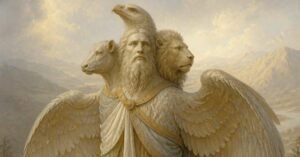
Ezekiel provides one of the most detailed descriptions of unusual heavenly beings in the Bible.
In Ezekiel 1, the prophet sees four living creatures. Later, in Ezekiel 10, these creatures are identified with cherubim.
The description includes multiple faces, wings, human-like hands, unusual feet, and an extraordinary connection with fiery wheels.
The creatures move with remarkable speed and are closely connected with God’s glory.
What Do the Cherubim Look Like?
Ezekiel’s description includes several striking features.
- Four faces
- Four wings
- Human-like hands beneath the wings
- Straight legs
- Feet described in an unusual animal-like way
- A shining or fiery appearance
- Close association with the mysterious wheels
The four faces are associated with a human, lion, ox, and eagle in Ezekiel’s vision.
These details are among the main reasons images of “biblically accurate angels” often look so dramatically different from traditional European angel paintings.
Why Do Cherubim Have Four Faces?
The Bible does not provide a simple sentence explaining why Ezekiel’s cherubim have four faces.
Readers and scholars have proposed various symbolic interpretations, often connecting the faces with different aspects of creation, strength, intelligence, royalty, or living creatures.
However, these interpretations should be distinguished from what the biblical text directly states.
The safest description is simply that Ezekiel’s vision presents heavenly creatures with four faces representing a human, lion, ox, and eagle.
The Wheels in Ezekiel’s Vision
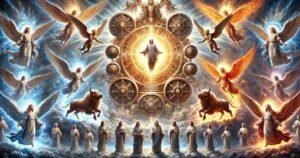
Another major part of the modern “biblically accurate angel” discussion involves the mysterious wheels in Ezekiel 1 and 10.
Ezekiel describes wheels beside the living creatures.
They appear like a wheel within a wheel and are described as being covered with eyes.
The wheels move together with the living creatures and appear in connection with the divine throne.
These wheels are often called ophanim in later Jewish and Christian discussion. The Hebrew word is associated with wheels.
Are the Ophanim Actually Angels?
This question requires some care.
The Bible describes the wheels in Ezekiel’s vision, but the term “ophanim” and the classification of these beings within a formal angelic hierarchy come from later traditions.
Some Christian theological traditions have treated the wheels as a particular class of heavenly beings, while others simply emphasize what Ezekiel himself describes.
Therefore, it is better to say that the wheels are heavenly beings or elements of Ezekiel’s heavenly vision rather than claiming that the Bible explicitly gives them a standardized angelic rank.
What Do Ophanim Look Like?
The wheels in Ezekiel’s vision are described as:
- Wheel-like
- Associated with a wheel within a wheel
- Moving in multiple directions
- Covered with eyes around their rims
- Shining or gleaming
- Closely connected with the living creatures
This is one of the most visually unusual descriptions in the Bible.
What Are the “Eyes” on Biblically Accurate Angels?
Eyes are an important feature in several biblical descriptions.
Ezekiel describes the wheels as having eyes around them, while the living creatures are also described with eyes in Ezekiel 10.
Revelation 4 similarly describes four living creatures as being full of eyes around and within.
These descriptions have led to some of the most recognizable modern images associated with biblically accurate angels.
The eyes should not automatically be interpreted as a literal anatomical blueprint for every angel. They belong to specific visionary descriptions in Scripture.
Living Creatures in the Bible
The phrase living creatures appears in several important biblical passages.
Ezekiel sees four living creatures in his vision. Later, he identifies them with cherubim.
Revelation also describes four living creatures around God’s throne.
These Revelation creatures have characteristics that resemble some of the earlier descriptions while also having their own details.
The Four Living Creatures in Revelation
Revelation 4 describes four living creatures around God’s throne.
The first resembles a lion, the second an ox, the third has a human-like face, and the fourth resembles an eagle in flight.
They are described as having six wings and being full of eyes.
They continually praise God and proclaim His holiness.
These creatures are one reason biblical angel imagery can be much more complex than the familiar two-winged human figure.
Are the Living Creatures Angels?
The Bible does not always use the word “angel” as a blanket term for every heavenly creature.
Some later Christian traditions place various heavenly beings into angelic categories, but the biblical passages themselves sometimes use distinct terms and descriptions.
This is why it is useful to distinguish between what Scripture explicitly says and later angelology, which developed elaborate systems for classifying heavenly beings.
What Are Archangels?
The word archangel refers to a chief or leading angelic figure in Christian terminology.
The Bible specifically names Michael as an archangel in Jude 1:9.
Michael is also described in Daniel and Revelation as a powerful heavenly warrior and protector.
Gabriel is another named heavenly messenger in Scripture, although the biblical text does not explicitly call Gabriel an archangel in the same way it calls Michael an archangel.
What Does Michael Look Like?
The Bible does not provide a detailed physical description of Michael’s face, body, wings, clothing, or exact appearance.
Michael is presented primarily through his actions and role.
He is associated with conflict against spiritual enemies and is described as a prince and protector.
Popular artwork often depicts Michael as a powerful winged warrior holding a sword. However, the Bible does not provide a detailed visual description that establishes this exact artistic appearance.
What Does Gabriel Look Like?
Gabriel is a messenger associated with important announcements in both Daniel and the Gospel of Luke.
Gabriel explains visions to Daniel and later appears in connection with the announcements concerning John the Baptist and Jesus.
However, Scripture does not provide a detailed physical portrait of Gabriel.
Modern paintings often depict Gabriel with wings, robes, or a glowing appearance, but these details belong to artistic tradition rather than a complete biblical description.
Are Angels Male or Female?
The Bible’s named and narrated angelic appearances are generally described using masculine language or male-presenting human forms.
However, Scripture does not provide a systematic discussion establishing human-style biological sex for all angels.
Therefore, it is safer to say that biblical narratives commonly portray angels using masculine language and appearances rather than making broad claims about angelic biology.
Do Angels Have Halos?
The Bible does not describe angels as wearing halos.
The halo became an important artistic symbol in Christian art and is often used to indicate holiness or heavenly status.
Because halos are so common in paintings, many people assume they are biblical features.
However, there is no biblical passage that says angels have circular glowing halos around their heads.
Do Angels Have White Robes?
Some biblical passages describe heavenly beings in bright or white clothing, but this does not establish a universal uniform for every angel.
White clothing became strongly associated with angels in Christian art because of its connection with purity, holiness, resurrection, and heavenly glory.
When studying biblically accurate angels, it is therefore useful to distinguish between biblical clothing descriptions and later artistic conventions.
Do Angels Have Feathers?
The Bible describes wings, but it does not describe angel wings as being made of feathers.
This is another detail added by artistic tradition.
When Scripture describes seraphim and cherubim as having wings, the text does not provide a detailed biological description of those wings.
Consequently, images of feathered wings are artistic interpretations rather than a complete biblical specification.
Are Angels Beautiful?
Some biblical encounters describe heavenly beings as glorious, radiant, or impressive, but the Bible does not establish one standard physical definition of angelic beauty.
Some angels appear in human-like forms, while prophetic visions contain creatures that would look extremely unusual by ordinary human standards.
Beauty is therefore not a reliable way to identify an angel according to Scripture.
Are Biblically Accurate Angels Scary?
Some biblical heavenly beings can certainly appear frightening or overwhelming.
Isaiah’s vision involves smoke, shaking thresholds, fiery imagery, and powerful heavenly beings. Ezekiel’s vision includes creatures with multiple faces, wings, fire, lightning, and mysterious wheels covered with eyes.
At the same time, not every biblical angel is presented as terrifying.
Some angels appear as messengers in relatively ordinary human form.
Therefore, the most accurate answer is that biblical angelic appearances are varied.
Why Are Biblical Angels Different From Popular Angel Art?
Christian art developed over many centuries.
Artists often needed visual symbols that ordinary people could immediately recognize. Wings became a powerful visual symbol for heavenly beings, while halos represented holiness and divine association.
Over time, these artistic conventions became so familiar that they were sometimes mistaken for direct biblical descriptions.
The modern phrase “biblically accurate angels” draws attention to the difference between these artistic traditions and the unusual imagery found in biblical visions.
Do Angels Have Different Types?
The Bible mentions different heavenly beings and titles, but it does not provide a single comprehensive hierarchy that ranks every angelic being from highest to lowest.
Later Christian theologians developed elaborate angelic hierarchies, including categories such as seraphim, cherubim, thrones, dominions, virtues, authorities, principalities, archangels, and angels.
These systems are important in Christian theological history, but they should not be presented as a simple chart explicitly provided by the Bible.
Common Types of Biblically Described Heavenly Beings
When people search for types of biblically accurate angels, they are usually referring to several groups mentioned in Scripture.
- Angels
- Archangel Michael
- Gabriel
- Cherubim
- Seraphim
- Living creatures
- Wheels associated with Ezekiel’s vision
Some of these are explicitly called angels, while others are described as distinct heavenly creatures.
Angels as Messengers
One of the clearest functions of angels in Scripture is communication.
Angels deliver messages to people in important moments of biblical history.
Gabriel’s announcements to Zechariah and Mary are among the best-known examples in the New Testament.
Angels also appear to Joseph through dreams and deliver divine instructions.
This messenger role explains why the word “angel” is closely associated with the idea of a messenger.
Angels as Protectors
Angels are also associated with protection and divine intervention.
Psalm 91:11 speaks about God commanding His angels concerning His people. Other passages describe angels protecting or rescuing individuals.
However, the biblical picture should not be reduced to the modern idea that every person necessarily has one invisible angel assigned exclusively to them.
The Bible contains passages that have been interpreted in support of guardian angels, but Christian traditions differ regarding exactly what those passages mean.
Are Guardian Angels in the Bible?
The idea of a guardian angel is common in Christianity and popular culture.
Psalm 91:11 is often cited in discussions about angelic protection, while Matthew 18:10 is another passage frequently discussed in connection with angels watching over children.
However, Scripture does not clearly provide a universal statement saying that every individual has one personal guardian angel assigned to them throughout life.
Therefore, Christians may understand these passages differently depending on their theological tradition.
Do Angels Protect Humans?
Yes, the Bible contains multiple examples of angels intervening on behalf of people.
Angels help Lot and his family, appear to Daniel, assist Peter, and participate in many other events.
However, their protection is presented as part of God’s activity rather than as independent supernatural power belonging to angels themselves.
Do Angels Worship God?
Yes. Worship is a major theme in biblical descriptions of heavenly beings.
The seraphim in Isaiah continually proclaim God’s holiness.
The living creatures in Revelation likewise worship God continually.
Angels in Revelation also appear repeatedly in scenes of praise and heavenly worship.
This emphasizes an important biblical principle: angels are servants of God, not beings who should receive worship themselves.
Should Christians Worship Angels?
No. Biblical passages consistently direct worship toward God rather than angels.
Revelation contains an important example in which John falls before an angel and is corrected. The angel tells him to worship God.
This is significant because it distinguishes angels from God. Even extraordinary heavenly beings are presented as servants rather than objects of worship.
Are Angels More Powerful Than Humans?
Biblical passages portray angels as powerful supernatural beings, but their power remains subordinate to God.
Angels can perform extraordinary acts, deliver messages, fight spiritual enemies, and execute divine judgment.
However, Scripture never presents angels as equal to God.
Their authority comes from their relationship to God and their role as His servants.
What Are Fallen Angels?
The Bible refers to angels who rebelled against God and were judged.
New Testament passages discuss angels who sinned and are being held for judgment.
The concept of fallen angels became much more developed in later Jewish and Christian traditions.
Popular culture often combines many different traditions about demons, fallen angels, Satan, and other spiritual beings. These ideas should be distinguished from the exact claims made in individual biblical passages.
Was Satan an Angel?
Christian tradition commonly understands Satan as a fallen heavenly being who rebelled against God.
The biblical picture is developed from several passages rather than from one single verse that gives a complete biography of Satan’s fall.
Revelation explicitly describes Satan as being cast down, while other passages have historically been interpreted in connection with his fall.
Some traditional interpretations connect Isaiah 14 and Ezekiel 28 with Satan, although those passages directly address historical figures or contexts and their application to Satan has been debated.
Therefore, it is important not to present every later Christian interpretation as though it were an explicit statement of the biblical text.
Are Demons Fallen Angels?
Christian traditions commonly connect demons with fallen angels, but the biblical terminology is more complicated than the simplified phrase suggests.
The New Testament clearly describes evil spiritual beings and angels who sinned.
Later Christian theology developed a more systematic understanding of demons as fallen angels.
When researching biblically accurate angels and demons, it is therefore useful to separate direct biblical descriptions from later theological traditions.
Biblically Accurate Angels in Ezekiel 1
Ezekiel 1 is one of the most important chapters for understanding the unusual imagery associated with biblical heavenly beings.
Ezekiel describes a vision involving four living creatures, fire, lightning, wings, faces, and wheels.
The creatures move together, and the wheels move with them.
Above the creatures is an appearance resembling a throne, and above the throne is a figure associated with God’s glory.
The passage is highly visual and symbolic, which is why artists and readers have interpreted it in many different ways.
Biblically Accurate Angels in Ezekiel 10
Ezekiel 10 revisits the extraordinary heavenly imagery and explicitly connects the living creatures with cherubim.
The chapter describes the cherubim and the wheels together, reinforcing the connection between Ezekiel’s earlier vision and this later scene.
The imagery includes wings, eyes, wheels, fire, and divine glory.
For anyone researching biblically accurate angels Ezekiel 1, reading both Ezekiel 1 and Ezekiel 10 is especially useful.
Biblically Accurate Angels in Isaiah 6
Isaiah 6 provides the clearest biblical description of seraphim.
The seraphim have six wings and are positioned around God’s throne.
Their repeated declaration of God’s holiness is one of the best-known heavenly worship scenes in Scripture.
The passage also emphasizes the holiness and majesty of God, rather than focusing on the seraphim as independent objects of fascination.
Biblically Accurate Angels in Revelation
The Book of Revelation contains some of the Bible’s most dramatic descriptions of angels and heavenly creatures.
Angels appear throughout the book as messengers, worshipers, warriors, and agents involved in God’s judgments.
The four living creatures around God’s throne have multiple wings and many eyes.
Revelation therefore contributes significantly to the modern discussion of what a “biblically accurate angel” might look like.
Why Do Biblical Angels Have So Many Strange Features?
Many of the most unusual angelic descriptions occur in prophetic visions.
Prophetic literature frequently uses vivid imagery to communicate ideas about God’s glory, holiness, judgment, power, and the heavenly realm.
That means readers should be cautious about treating every visual detail as though it were a scientific description of a physical creature.
The biblical authors were communicating visions and theological realities through imagery.
Are Biblically Accurate Angels Literal or Symbolic?
Christians differ in how they interpret some of the visionary descriptions.
Some understand the creatures as literal heavenly beings whose appearances are genuinely unusual.
Others place greater emphasis on the symbolic meaning of the visions.
For example, eyes can communicate awareness, while wings can communicate movement or heavenly activity. However, interpretations vary, and the biblical text does not always explain every symbol.
A responsible article should therefore distinguish between the description itself and interpretations of what every feature means.
What Do Biblically Accurate Angels Really Look Like?
There is no single answer.
Some biblical angels appear in human-like forms.
Seraphim are described with six wings.
Cherubim in Ezekiel have four faces and four wings.
The living creatures in Revelation have multiple wings and many eyes.
Ezekiel’s mysterious wheels have eyes around their rims.
Other angels simply appear as heavenly messengers without an extensive physical description.
Therefore, biblically accurate angels are diverse rather than having one standardized appearance.
Common Myths About Angels
Myth 1: Every angel has two wings
The Bible does not say this. Some heavenly beings have multiple wings, while ordinary angels are not always described with wings.
Myth 2: Every angel has a halo
Halos are primarily an artistic convention. Scripture does not describe angels as wearing halos.
Myth 3: Cherubim are baby angels
The biblical descriptions of cherubim are much more powerful and complex than the baby-like figures common in European art.
Myth 4: All angels are women
The biblical narratives involving angels generally use masculine language or masculine human forms.
Myth 5: Humans become angels after death
The Bible does not teach that human beings become angels after death.
Myth 6: Angels should be worshiped
Scripture directs worship toward God, not angels.
Do Humans Become Angels When They Die?
This is a common belief in popular culture, but it is not a biblical teaching.
The Bible distinguishes human beings from angels.
Jesus discusses the resurrection and says that resurrected people are like angels in certain respects, particularly concerning marriage, but this does not mean that humans literally transform into angels.
Christian teachings about the afterlife vary in detail, but the idea that every person becomes an angel after death is not presented as a biblical doctrine.
Are Angels Gods?
No.
Angels are created beings who serve God.
They may possess supernatural power and appear in glorious forms, but Scripture consistently distinguishes them from God.
The biblical emphasis is that angels serve God’s purposes and direct worship toward Him.
Why Biblically Accurate Angels Matter
Studying biblical descriptions of angels can help readers understand Scripture more carefully.
Instead of assuming that every familiar image comes directly from the Bible, readers can examine the actual passages and compare them with later artistic traditions.
This can make biblical passages such as Isaiah 6, Ezekiel 1, Ezekiel 10, and Revelation 4 much easier to appreciate.
It also reminds readers that the Bible’s descriptions of the unseen world are not always simple or predictable.
Biblically Accurate Angels and Christian Faith
For Christians, the most important point about angels is not simply what they look like.
The biblical stories consistently place angels within God’s larger story.
They announce God’s plans, deliver messages, protect people, execute judgment, worship God, and participate in heavenly events.
Their role ultimately points beyond themselves toward God.
What Can We Learn From Biblical Angels?
Several themes emerge from the biblical descriptions.
- God’s holiness: Heavenly beings repeatedly respond to God’s holiness with worship.
- God’s authority: Angels act under God’s authority rather than independently.
- Service: Angels frequently serve as messengers and servants.
- Protection: Some passages describe angels protecting or helping people.
- Judgment: Angels can also participate in divine judgment.
- Mystery: Scripture leaves many details about the heavenly realm unexplained.
How to Read Bible Verses About Angels
When studying angels, context is extremely important.
Instead of taking one unusual description and assuming it applies to every angel, readers should examine the entire passage.
Ask questions such as:
- Who is speaking?
- Who is seeing the vision?
- Is this a normal encounter or a prophetic vision?
- Is the being called an angel?
- What does the being do?
- Does the passage explain the symbolism?
- Is the description repeated elsewhere?
This approach helps prevent assumptions from being presented as biblical facts.
Biblically Accurate Angels: A Simple Comparison
| Being | Biblical Description |
|---|---|
| Angels | Often appear as messengers; detailed appearance is not always given. |
| Michael | Named archangel and heavenly warrior; detailed physical appearance is not provided. |
| Gabriel | Messenger who explains visions and delivers major announcements. |
| Seraphim | Six wings; associated with God’s throne and worship. |
| Cherubim | Ezekiel describes four faces, four wings, eyes, and unusual features. |
| Living Creatures | Described in Ezekiel and Revelation with multiple faces, wings, and eyes. |
| Wheels | Ezekiel describes wheels within wheels with eyes around them. |
Frequently Asked Questions About Biblically Accurate Angels
What are biblically accurate angels?
Biblically accurate angels refers to depictions or descriptions based on what Scripture actually says about angels and heavenly beings rather than relying solely on traditional artwork.
What do biblically accurate angels look like?
There is no single appearance. Some angels appear human-like, while other heavenly beings are described with multiple wings, faces, eyes, fire, and unusual forms.
Do biblically accurate angels have wings?
Some heavenly beings described in Scripture have wings, but the Bible does not say every angel has wings.
How many wings do seraphim have?
Isaiah 6 describes seraphim as having six wings.
How many wings do cherubim have?
Ezekiel’s vision describes cherubim with four wings.
Do cherubim have four faces?
Ezekiel’s description of the living creatures later identified as cherubim includes four faces: human, lion, ox, and eagle.
What are ophanim?
Ophanim is a later term associated with the mysterious wheels described in Ezekiel’s visions. The biblical passage itself describes wheels within wheels with eyes around them.
Do angels have eyes all over their bodies?
Specific heavenly beings in Ezekiel and Revelation are described as being covered with or surrounded by eyes. This should not automatically be applied to every angel in the Bible.
Do angels have halos?
The Bible does not describe angels as wearing halos. Halos became an important feature of Christian artistic tradition.
Do angels have feathers?
The Bible describes wings for certain heavenly beings but does not specifically say that their wings are made of feathers.
Are angels scary according to the Bible?
Some biblical angelic encounters are frightening or overwhelming, while others involve angels appearing in human-like forms. The biblical picture is varied.
Are cherubim baby angels?
No. The popular baby-like depiction of cherubim does not match the major biblical descriptions of cherubim.
Are seraphim angels?
Seraphim are heavenly beings described in Isaiah 6. They are commonly included within Christian discussions of angelic beings.
Is Michael an archangel?
Yes. Jude 1:9 explicitly refers to Michael as an archangel.
Is Gabriel an archangel?
Gabriel is a named heavenly messenger in Daniel and Luke. While Christian tradition often calls him an archangel, the canonical biblical passages do not explicitly use the title “archangel” for Gabriel in the same way Jude does for Michael.
Do humans become angels when they die?
No. The Bible does not teach that humans transform into angels after death.
Should angels be worshiped?
No. Biblical passages direct worship toward God rather than angels.
Are demons fallen angels?
Christian tradition commonly connects demons with fallen angels, but the biblical terminology and later theological development should be distinguished carefully.
Related Articles
If you are interested in the meaning and biblical background of names, read our
Emily Meaning guide to explore its origin, meaning, history, and biblical connections.
You can also explore our Henry Name Meaning guide to learn more about the origin, meaning, history, and biblical context of the name Henry.
visit
Bible Gateway’s guide to Biblically Accurate AngelsFor additional Bible verses and explanations about the appearance and nature of angels,
see
Bible Study Tools’ article on Biblically Accurate Angels
For a discussion of how biblical descriptions differ from popular artistic images of angels,
read
Mental Floss’s article about what biblically accurate angels look like
For another discussion of biblical angel descriptions and interpretations,
you can also explore
Town of Cross Hollow’s discussion of biblically accurate angels
Final Thoughts on Biblically Accurate Angels
Biblically accurate angels are much more diverse than the familiar image of a beautiful human figure with two white wings and a halo.
The Bible describes angels who act as messengers, servants, protectors, and agents of God’s purposes. It also describes extraordinary heavenly beings such as seraphim and cherubim, along with the mysterious living creatures and wheels associated with Ezekiel’s visions.
Seraphim are described with six wings. Ezekiel’s cherubim have four wings and four faces. The living creatures in Revelation have multiple wings and are described as being full of eyes. The mysterious wheels in Ezekiel are described as wheels within wheels with eyes around them.
At the same time, not every angel in Scripture receives an elaborate physical description. Some appear as human-like messengers, which means there is no single appearance that can accurately represent every biblical angel.
The most important lesson is that biblical angels are not presented as objects of worship. They serve God, communicate His messages, carry out His purposes, and participate in scenes of heavenly worship.
So when you search for biblically accurate angels, the best approach is not to look for one definitive angel picture. Instead, look at the individual biblical passages and allow each description to speak within its own context.