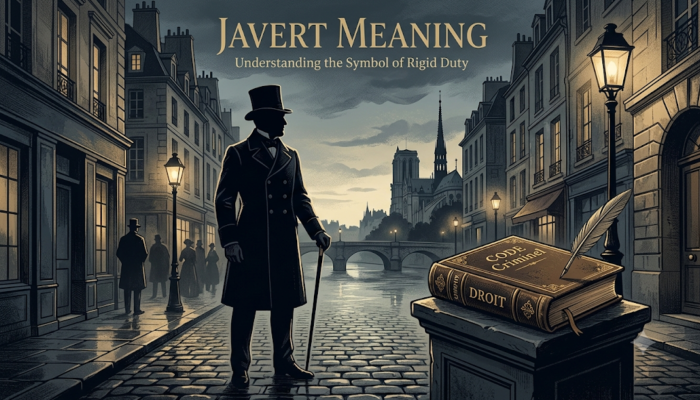
If you searched for “Javert meaning”, you may be wondering whether Javert is a name, what it means, where it comes from, or why it is so closely associated with law, justice, and Les Misérables. Javert is best known as Inspector Javert, one of the central characters in Victor Hugo’s famous novel Les Misérables.
Unlike many common first names with a straightforward dictionary definition, Javert meaning is strongly connected with literature and the character created by Victor Hugo. Javert’s identity, beliefs, actions, and conflict with Jean Valjean give the name powerful symbolic associations with law, order, duty, justice, morality, and rigid thinking.
In this comprehensive guide, we explore Javert name meaning, origin, pronunciation, symbolism, personality, role in Les Misérables, relationship with Jean Valjean, appearance in the musical and film adaptations, and the deeper ideas represented by this famous literary character.
Quick Answer: What Does Javert Mean?
Javert is primarily known as the surname of Inspector Javert, a fictional police inspector in Victor Hugo’s Les Misérables. The character is strongly associated with law, order, justice, duty, authority, and an uncompromising belief in rules.
When people search for “what does Javert mean?”, they are often asking about the meaning or symbolism of the character rather than a traditional dictionary definition of a personal name. In the story, Javert represents a strict view of justice in which the law must be followed and criminals must be punished.
Quick answer: Javert is best understood as the name of Inspector Javert from Les Misérables, a character who symbolizes strict law, authority, order, and an inflexible idea of justice.
Table of Contents
- What Does Javert Mean?
- Javert Origin and Background
- Is Javert a Name?
- Javert French Meaning
- Javert Name Meaning
- How to Pronounce Javert
- Javert in Les Misérables
- Who Is Inspector Javert?
- What Is Javert’s Role in Les Misérables?
- Javert and Jean Valjean
- Javert’s Personality
- What Does Javert Symbolize?
- Javert and the Law
- Javert and Justice
- Javert and Morality
- What Did Javert Believe?
- Why Is Javert Obsessed With Jean Valjean?
- Javert’s Character Development
- Javert Character Traits
- Javert in Victor Hugo’s Novel
- Javert in the Les Misérables Musical
- Javert in Film Adaptations
- Famous Javert Quotes
- Javert as a Literary Character
- What Does Javert Represent?
- Javert Meaning and Modern Usage
- Javert vs. Jean Valjean
- Could Javert Have Been Redeemed?
- Javert’s Conflict Between Law and Mercy
- Why Is Javert Important in Les Misérables?
- Is Javert a Villain?
- Lessons From Javert’s Character
- 25+ Facts About Javert
- Frequently Asked Questions About Javert
- Final Thoughts on Javert Meaning
Javert Meaning

The meaning associated with Javert comes primarily from its literary use. In Victor Hugo’s Les Misérables, Inspector Javert is a police officer whose life is built around enforcing the law.
Because of his role, the name Javert has become closely associated with ideas such as law enforcement, discipline, authority, justice, rules, duty, and order. It is therefore different from a name whose meaning comes from a commonly documented word or ancient linguistic root.
For readers familiar with Les Misérables, the name immediately brings Inspector Javert to mind. His relentless pursuit of Jean Valjean is one of the most important conflicts in the story.
The broader Javert character meaning can therefore be understood through his actions and beliefs. He believes strongly in the established legal system and has difficulty accepting circumstances in which compassion, redemption, or personal morality conflict with the law.
What Is the Origin of Javert?
The most important origin of the name Javert is its appearance as a fictional surname in Victor Hugo’s Les Misérables. Javert is not primarily known because of a traditional English or biblical naming tradition. Instead, its significance comes from French literature.
Victor Hugo published Les Misérables in 1862. The novel follows several interconnected characters and explores poverty, social inequality, law, morality, redemption, compassion, and justice.
Inspector Javert plays an important role because he provides a strong contrast to Jean Valjean. Valjean’s story is centered on transformation and redemption, while Javert is deeply committed to the belief that people who break the law remain defined by their wrongdoing.
As a result, the origin and meaning of Javert are best understood through the character’s literary context rather than by assigning an unsupported literal translation to the name.
Is Javert a Name?
Yes. Javert is a name, specifically the surname of a fictional character. Inspector Javert is one of the best-known characters in Victor Hugo’s Les Misérables.
However, it is important to distinguish between a name’s literary association and a traditional etymological meaning. When someone searches for Javert name meaning, the safest explanation is that the name is strongly recognized through Victor Hugo’s character.
The character’s identity has made Javert recognizable far beyond the original French novel. The name appears in translations, stage productions, musical adaptations, films, educational discussions, and literary analysis.
Javert Meaning in French

Javert is a French literary surname associated most famously with Inspector Javert in Les Misérables. It should not automatically be treated as a French vocabulary word meaning “law” or “justice.”
Instead, the association with law and justice comes from Javert’s role and characterization. He is a police inspector who dedicates himself to enforcing the law and pursuing Jean Valjean.
Therefore, when discussing Javert meaning in French, it is useful to separate the name itself from the symbolic meaning it has acquired through literature.
Javert Name Meaning
The Javert name meaning is closely connected to Inspector Javert and the themes surrounding him. Readers commonly associate the name with law, authority, discipline, justice, order, duty, and strict morality.
These associations do not necessarily mean that the literal etymology of Javert translates into each of these concepts. Rather, they describe what the character represents in Les Misérables.
For literary purposes, Javert can therefore be understood as a name carrying strong symbolic associations with institutional authority and uncompromising legal thinking.
Javert Pronunciation
Javert is a French name, so its pronunciation can sound different depending on whether the speaker is using French pronunciation or an English pronunciation commonly heard in adaptations of Les Misérables.
English-speaking audiences may pronounce the name differently from native French speakers. The pronunciation also varies somewhat between stage productions, films, audiobooks, and individual speakers.
How to Pronounce Javert
A commonly heard English pronunciation is approximately “zhah-VAIR”, although pronunciation can vary depending on accent and language.
For a closer French pronunciation, the final sound should not be pronounced exactly like the English word “vert.” Listening to a reliable French pronunciation source is the best way to reproduce the original pronunciation accurately.
Javert in Les Misérables
Javert in Les Misérables is one of the principal figures who drives the conflict of the story. He serves as a police inspector and becomes particularly determined to capture Jean Valjean.
Valjean has previously been imprisoned and later attempts to build a new life. His transformation creates a major moral challenge to Javert’s worldview because Valjean demonstrates that a person can change.
Javert, however, struggles to accept this idea. His understanding of people is strongly connected to their legal status and past actions.
This conflict between law and mercy is one of the central themes represented by the two characters.
Who Is Inspector Javert?

Inspector Javert is a police inspector in Victor Hugo’s Les Misérables. He is one of the main figures opposing Jean Valjean throughout the story.
Javert is committed to his duties and believes that the law must be enforced. His pursuit of Valjean continues even when the circumstances become morally complicated.
He is not simply presented as an ordinary villain. His character represents a particular philosophy of justice and social order. His tragedy comes from the difficulty of reconciling that philosophy with evidence that people can change.
Javert’s Role in Les Misérables
Javert’s role extends beyond being a police officer who follows Jean Valjean. He represents one side of the novel’s larger debate about law, justice, morality, punishment, and redemption.
Jean Valjean’s life challenges Javert’s assumptions. Valjean repeatedly demonstrates kindness, responsibility, and sacrifice despite his criminal past.
Javert finds this difficult to understand because his worldview depends on clear categories. In his thinking, a person who has broken the law is fundamentally connected to that identity.
This makes Javert an important literary contrast to Valjean and helps explain why their relationship is so significant.
Javert and Jean Valjean
The relationship between Javert and Jean Valjean is one of the most important conflicts in Les Misérables.
Valjean has served a prison sentence and later changes his life. Javert remains convinced that Valjean must ultimately answer for his past.
Their relationship represents a deeper conflict between two different ideas of justice. Javert emphasizes the authority of established law, while Valjean’s story demonstrates the possibility of moral transformation.
This is why searches such as “why does Javert hate Jean Valjean?” are so common. Javert’s pursuit is not simply personal hatred. It is rooted in his understanding of law, duty, and criminal identity.
Javert’s Personality
Javert is portrayed as serious, disciplined, determined, authoritative, and highly committed to his work.
He does not easily accept ambiguity. His thinking tends to divide the world into clear categories such as lawful and unlawful, criminal and respectable, guilty and innocent.
His dedication can appear admirable when viewed as commitment to duty, but the same rigidity becomes a weakness when circumstances require compassion or flexibility.
Important Personality Traits
- Strict: Javert strongly follows rules and regulations.
- Disciplined: He is highly committed to his professional responsibilities.
- Determined: He refuses to abandon his pursuit of Valjean easily.
- Authoritative: His identity is closely connected with institutional power.
- Rigid: He struggles with situations that do not fit his established worldview.
- Duty-driven: His sense of responsibility strongly influences his decisions.
What Does Javert Symbolize?
What Javert symbolizes is one of the most frequently discussed aspects of his character.
Javert commonly symbolizes law, institutional authority, order, rigid justice, duty, and an inflexible moral system.
His character also illustrates what can happen when a person relies so completely on one system of values that they cannot adapt when reality challenges that system.
At the same time, Javert’s symbolism should not be reduced to simply “bad law” or “evil authority.” His character is more complicated. He sincerely believes that enforcing the law protects society.
The tragedy lies in the conflict between his absolute worldview and the complexity of human morality.
Javert as a Symbol of Law
Javert is one of the clearest representations of law and legal authority in Les Misérables.
His profession, behavior, and beliefs all reinforce this symbolism. He sees obedience to the law as a fundamental requirement of an orderly society.
His pursuit of Valjean demonstrates how strongly he identifies with the legal system. Even when Valjean shows evidence of personal transformation, Javert has difficulty separating the man he sees from the criminal identity associated with his past.
This makes Javert a useful literary example of the tension between legal justice and personal morality.
Javert and Justice
Justice is central to understanding Javert. He believes that people who violate the law should face its consequences.
His idea of justice is highly structured. He does not easily make exceptions based on personal circumstances or emotional considerations.
Jean Valjean challenges this approach because his life shows that a person can commit wrongdoing and later become compassionate, responsible, and self-sacrificing.
The contrast encourages readers to consider whether justice should focus only on past actions or also recognize a person’s ability to change.
Javert and Morality
Javert’s morality is strongly connected to duty and obedience. He believes that following the established rules is morally necessary.
However, the story places him in situations where legal rules and compassionate action appear to conflict.
This creates one of the central moral tensions surrounding his character. Javert is not necessarily motivated by personal greed or a desire for power. Instead, he genuinely believes in the system he serves.
His difficulty is that his moral framework leaves little room for forgiveness, redemption, or exceptions.
Javert’s Beliefs
Javert believes strongly in the importance of social order. He places considerable faith in the legal system and in the authority of law enforcement.
His beliefs also influence the way he views people. He tends to categorize individuals according to their relationship with the law.
This explains his difficulty with Jean Valjean. Valjean does not remain the same person he was when he committed his earlier crime, but Javert struggles to accept that transformation.
Why Is Javert Obsessed With Valjean?
Javert’s pursuit of Valjean is driven primarily by his commitment to law enforcement and his belief that Valjean remains connected to his criminal past.
Valjean repeatedly escapes or changes his circumstances, but Javert continues searching for him. Their relationship therefore becomes more than a conventional police pursuit.
Valjean represents the possibility of transformation, while Javert represents a system that has difficulty accepting such transformation.
This is why their conflict remains one of the most memorable elements of Les Misérables.
Javert’s Character Development
Javert experiences an important internal crisis as the story progresses. His worldview depends on the assumption that law, justice, and morality can be clearly defined.
His encounters with Valjean challenge this assumption.
As Valjean repeatedly demonstrates compassion and moral responsibility, Javert is forced to confront situations that cannot easily be explained through his rigid understanding of law.
His character development is therefore less about becoming a completely different person and more about confronting the limits of his existing beliefs.
Javert’s Most Important Traits
The most recognizable Javert character traits include discipline, determination, strictness, authority, loyalty to duty, and inflexibility.
| Trait | How It Appears in Javert |
|---|---|
| Discipline | He takes his professional responsibilities seriously. |
| Determination | He persistently pursues Jean Valjean. |
| Authority | He represents the power of the legal system. |
| Strictness | He expects people to follow established rules. |
| Rigidity | He struggles with situations that challenge his worldview. |
| Duty | His decisions are strongly influenced by professional obligation. |
Javert in the Novel
In Victor Hugo’s original novel, Javert is an important part of the story’s exploration of law and morality.
The novel gives readers a deeper opportunity to understand his worldview and the philosophical conflict surrounding his actions.
Because Les Misérables is a large and complex work, Javert’s role is connected to broader themes involving poverty, punishment, social institutions, compassion, and redemption.
Javert in the Musical
Javert became even more widely recognized through the stage musical adaptation of Les Misérables.
The musical presents his conflict with Valjean through dramatic songs and performances. One of the most important aspects of the musical portrayal is the way Javert’s certainty gradually comes under pressure.
Different actors have interpreted the role in different ways, but the central themes of law, duty, authority, and moral conflict remain important.
Javert in Film Adaptations
Javert has appeared in numerous screen adaptations of Les Misérables. Each adaptation may emphasize different aspects of his personality and relationship with Valjean.
Film performances can give the character a different emotional tone because facial expressions, body language, music, cinematography, and acting style add layers that are not available in the same way in written text.
Despite these differences, his central identity as an officer committed to law and order remains consistent.
Javert Quotes and Meaning
Javert is associated with memorable dialogue and musical moments that emphasize his beliefs about law and justice.
Rather than examining individual quotations in isolation, it is useful to consider what his words reveal about his worldview. His statements frequently reinforce ideas of authority, duty, punishment, and the importance of following established rules.
His dialogue becomes especially significant when contrasted with Valjean’s actions. The contrast between what Javert believes and what Valjean demonstrates creates much of the story’s moral tension.
Javert as a Literary Character
Javert is an example of a literary character whose importance extends beyond the events of the story.
He can be studied as a representation of institutional authority and rigid justice. His conflict with Valjean allows Victor Hugo to explore questions about whether justice should be based entirely on punishment and whether people should be permanently defined by their past.
This makes Javert particularly useful for discussions of character symbolism, morality, law, justice, redemption, and social order.
What Does the Name Javert Represent?
In literary discussions, the name Javert represents more than an individual character. It can evoke the ideas associated with Inspector Javert: law, authority, order, duty, discipline, and rigid justice.
However, these are symbolic associations rather than a definitive literal translation of the name.
If you are researching what the name Javert represents, the context of Les Misérables is therefore essential.
Javert Meaning in Modern Usage
Outside direct discussions of Les Misérables, the name Javert can sometimes be used as a cultural reference to someone perceived as extremely strict, rule-focused, or uncompromising.
Such usage depends heavily on context and on whether the audience knows the character.
For example, describing someone as “a Javert” could suggest that the person is acting like a strict enforcer of rules. This is a literary allusion rather than a standard everyday definition.
Javert vs. Jean Valjean
The contrast between Javert and Jean Valjean is central to understanding both characters.
| Javert | Jean Valjean |
|---|---|
| Represents strict legal authority | Represents personal transformation |
| Strongly identifies with duty | Changes through experience and compassion |
| Focuses on law and order | Demonstrates the possibility of redemption |
| Struggles with moral ambiguity | Lives through moral complexity |
| Views the past as highly significant | Works to create a different future |
This contrast is one reason Les Misérables remains an important work for discussions about justice and human morality.
Javert and the Theme of Redemption
Redemption is one of the most important themes in Les Misérables, and Javert helps highlight it through contrast.
Jean Valjean changes significantly during the story. His actions demonstrate that a person’s past does not necessarily determine every decision they will make in the future.
Javert has much greater difficulty accepting this concept. His worldview is based on fixed categories, making the idea of genuine transformation particularly difficult for him.
Javert therefore helps readers understand the importance of redemption by representing the opposite perspective.
Javert and the Meaning of Law vs. Mercy
The conflict between law and mercy is one of the strongest ideas associated with Javert.
Law provides structure and rules, while mercy recognizes individual circumstances and the possibility of change. Les Misérables repeatedly places these ideas into tension.
Javert’s decisions show what can happen when legal principles are treated as absolute and personal circumstances are given little importance.
At the same time, the story does not simply suggest that laws are unnecessary. Instead, it encourages readers to think about the relationship between legal justice and human compassion.
Why Is Javert an Important Character?
Javert is important because he gives the story a powerful opposing force to Jean Valjean.
Without Javert, Valjean’s transformation would not face the same level of pressure. Javert’s pursuit forces Valjean to confront the consequences of his past while continuing to make moral choices.
Javert also gives Victor Hugo an opportunity to examine institutions, punishment, authority, and the limits of rigid thinking.
Is Javert a Villain?
Javert is often treated as an antagonist because his actions repeatedly place him in opposition to Jean Valjean and other characters.
However, describing him simply as a villain can overlook an important part of his characterization. Javert genuinely believes that he is serving justice and fulfilling his duty.
His character is therefore more accurately understood through the conflict between his sincere beliefs and the moral complexity of the situations he encounters.
What Does Javert Teach Readers?
Javert encourages readers to think about the difference between following rules and understanding justice.
His character raises questions such as:
- Can a person genuinely change after making serious mistakes?
- Should justice consider a person’s circumstances?
- Can strict obedience to rules become harmful?
- What happens when law and compassion appear to conflict?
- How should society balance punishment with rehabilitation?
These questions help explain why Javert remains relevant in literary discussions more than a century after the publication of Les Misérables.
25+ Powerful Facts About Javert
- Javert is a fictional character created by Victor Hugo.
- He appears in Les Misérables.
- He serves as a police inspector.
- Jean Valjean is the central person he pursues.
- Javert strongly believes in law and order.
- He is highly committed to his professional duties.
- His worldview is relatively rigid.
- He represents institutional authority.
- He is closely connected with the theme of justice.
- His character contrasts strongly with Jean Valjean.
- Valjean’s transformation challenges Javert’s beliefs.
- Javert struggles with moral ambiguity.
- He is an important antagonist in the story.
- His character appears in musical adaptations.
- He has been portrayed by numerous actors.
- His character has appeared in film adaptations.
- He is one of the most recognizable figures in Les Misérables.
- His name is primarily recognized through French literature.
- “Javert” should not automatically be translated as “law” or “justice.”
- His symbolic meaning comes largely from his characterization.
- His relationship with Valjean drives major parts of the story.
- He represents a strict approach to legal justice.
- His character raises questions about redemption.
- His worldview is challenged by Valjean’s actions.
- His story demonstrates the limits of rigid thinking.
- Javert can be studied as a symbol of authority and social order.
- His character remains widely discussed in literary analysis.
Common Questions About Javert
What does Javert mean?
Javert is best known as the surname of Inspector Javert in Victor Hugo’s Les Misérables. The character is associated with law, authority, order, duty, and strict justice.
Is Javert a real name?
Javert is used as a name, but it is most famously recognized as the fictional surname of Inspector Javert from Les Misérables.
What does Javert symbolize?
Javert commonly symbolizes law, institutional authority, order, duty, rigid justice, and an uncompromising moral system.
Who is Inspector Javert?
Inspector Javert is a police inspector and major character in Victor Hugo’s Les Misérables. He is particularly known for pursuing Jean Valjean.
Why does Javert pursue Jean Valjean?
Javert pursues Valjean because he believes strongly in enforcing the law and holds Valjean responsible for his criminal past.
Is Javert a villain?
Javert functions as an antagonist, but his character is more complex than a simple villain. He sincerely believes that he is doing his duty and enforcing justice.
What does Javert represent in literature?
Javert represents strict legal authority and a rigid understanding of justice. His character contrasts with Valjean’s transformation and compassion.
How do you pronounce Javert?
A commonly heard English approximation is “zhah-VAIR,” although pronunciation varies between French and English speakers.
Is Javert a French name?
Javert is strongly associated with French literature because of Victor Hugo’s Les Misérables. Its most famous use is as Inspector Javert’s surname.
What is Javert’s relationship with Jean Valjean?
Javert is the police inspector who persistently pursues Valjean. Their conflict represents a larger tension between law, justice, mercy, and redemption.
Javert FAQs
What is the main meaning associated with Javert?
The strongest symbolic associations are law, authority, order, duty, and strict justice because of Inspector Javert’s role in Les Misérables.
What is Javert’s role in the story?
Javert serves as a police inspector and an important opposing force to Jean Valjean.
What does Javert symbolize in relation to Valjean?
Javert represents rigid law and institutional justice, while Valjean’s story emphasizes transformation, compassion, and redemption.
Was Javert created by Victor Hugo?
Yes. Inspector Javert is a fictional character created by French author Victor Hugo for Les Misérables.
Does Javert mean justice?
Javert should not automatically be treated as a literal translation of the word “justice.” Instead, justice is one of the major concepts symbolically associated with the character.
Why is Javert important in Les Misérables?
He creates a central conflict for Valjean and allows the novel to explore law, punishment, morality, compassion, and redemption.
Is Javert used as a literary reference?
Yes. In some contexts, calling someone “a Javert” can be a literary reference to a person perceived as highly strict, rule-focused, or uncompromising.
Sure, Shakeela Jii. Here are the Internal Links and External References separately, with the URL included directly in the anchor text and written as natural paragraphs.
- If you are interested in other name meanings and biblical name explanations, you can also explore Tristan in the Bible for another detailed look at the name and its connection to Scripture.
- Readers who enjoy learning the meanings of internet abbreviations can also check out ICL Meaning to understand how this popular abbreviation is used in digital conversations.
- For another commonly searched texting expression, explore GTS Meaning in Text to learn its meaning, usage, and examples.
- You can also read DSL Meaning Slang to discover how this abbreviation is used in casual online communication and different contexts.
- For additional information about the meaning and background of Javert, readers can explore GrammarVision’s Javert Meaning Guide for another perspective on the name.
- Another resource discussing the name is Kabalarians’ Javert Name Meaning, which provides additional information about the name and its interpretation.
- For readers interested in how Javert may be discussed in relation to texting or online language, SimileVibe’s Javert in Text Guide provides additional context.
- Since Javert is most famously associated with Victor Hugo’s Les Misérables, you can also explore GrammerAura’s Javert Meaning Guide for further discussion of the character and his significance.
Final Thoughts
The Javert meaning is best understood through the literary character created by Victor Hugo rather than through an unsupported literal translation of the name.
Inspector Javert is strongly associated with law, authority, justice, discipline, order, and duty. His relentless pursuit of Jean Valjean creates one of the central conflicts in Les Misérables.
At a deeper level, Javert represents the limitations of an inflexible worldview. His character contrasts with Valjean’s transformation and encourages readers to consider the relationship between law and mercy, punishment and redemption, and rules and human compassion.
Whether you searched for Javert name meaning, Javert pronunciation, Javert symbolism, or information about Inspector Javert in Les Misérables, understanding his literary context provides the clearest explanation of why this name remains recognizable today.