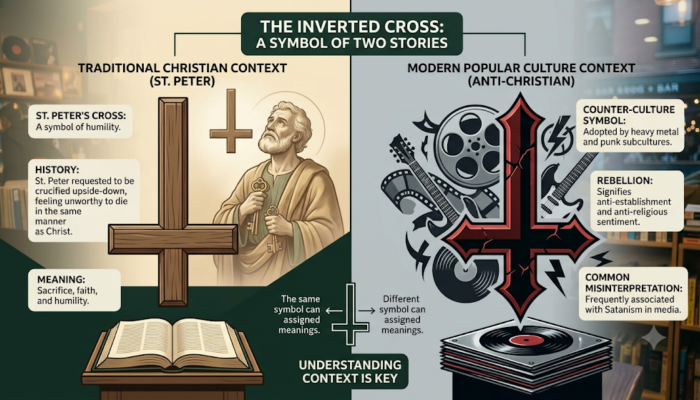
The symbol can have different meanings depending on its historical, religious, and cultural context. In Christian tradition, an upside down cross is commonly associated with St. Peter and is known as the Cross of St. Peter or Petrine Cross. It has traditionally been connected with humility, martyrdom, sacrifice, and devotion to Christ.However, the inverted cross has also been used in modern anti-Christian, Satanic, horror, music, and popular-culture settings. Because of these different uses, an upside down cross should not automatically be given one fixed meaning.In this guide, we will explore the upside down cross meaning, its connection to St. Peter, what the Bible actually says, Catholic symbolism, its association with Satanism, and how its meaning changes in modern culture.
Quick Answer: What Does an Upside Down Cross Mean?
An upside down cross traditionally represents the Cross of St. Peter. According to Christian tradition, Peter was crucified upside down because he considered himself unworthy to die in the same manner as Jesus. For this reason, the inverted cross can symbolize humility, martyrdom, sacrifice, and faith.
At the same time, the inverted cross has been used in some modern contexts as an anti-Christian or Satanic symbol. Therefore, its meaning depends on the context in which it appears.
Table of Contents
- What Is an Upside Down Cross?
- Why Is the Cross of St. Peter Upside Down?
- Was St. Peter Really Crucified Upside Down?
- Does the Bible Mention an Upside Down Cross?
- What Does the Upside Down Cross Mean in Christianity?
- What Is the Cross of St. Peter?
- What Does the Upside Down Cross Symbolize?
- Is an Upside Down Cross a Christian Symbol?
- Is an Upside Down Cross Satanic?
- Why Do People Associate the Inverted Cross With Satanism?
- Upside Down Cross vs. Upside Down Crucifix
- Upside Down Cross Meaning in Catholicism
- Does the Pope Use an Upside Down Cross?
- Upside Down Cross Meaning in Popular Culture
- What Does an Upside Down Cross Tattoo Mean?
- What Does an Upside Down Cross Necklace Mean?
- Why Is an Inverted Cross Sometimes Considered Evil?
- What Does the Upside Down Cross Mean Spiritually?
- Upside Down Cross Meaning in Different Contexts
- Upside Down Cross vs. Satanic Symbol
- Christian Tradition vs. Modern Interpretation
- Final Thoughts
- Frequently Asked Questions
What Is an Upside Down Cross?

An upside down cross is a traditional Christian cross turned vertically so that the shorter horizontal section appears closer to the bottom. It is also called an inverted cross.
Although many people today immediately associate the inverted cross with Satanism or dark imagery, its history is more complicated. In Christian tradition, the symbol is strongly connected with St. Peter, one of Jesus’ apostles.
The Cross of St. Peter is traditionally shown upside down because of the belief that Peter was crucified in an inverted position. The symbol therefore developed a meaning associated with humility and martyrdom.
At the same time, later cultural movements adopted the inverted cross for very different purposes. This is why understanding the surrounding context is essential when interpreting an upside down cross.
Why Is the Cross of St. Peter Upside Down?
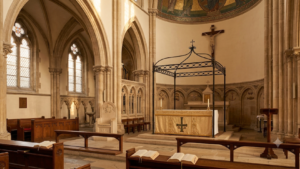
The main traditional explanation for the upside down Cross of St. Peter comes from accounts of Peter’s martyrdom.
According to Christian tradition, Peter was sentenced to crucifixion in Rome. The tradition says that Peter requested to be crucified upside down because he did not consider himself worthy to die in the same manner as Jesus Christ.
As a result, the inverted cross became associated with Peter’s humility, devotion, sacrifice, and martyrdom.
It is important to distinguish this Christian tradition from what is explicitly recorded in the Bible. Scripture does not directly state that Peter was crucified upside down.
Was St. Peter Really Crucified Upside Down?
The belief that St. Peter was crucified upside down is an important part of Christian tradition, but the specific detail is not directly described in the New Testament.
The Gospel of John records Jesus speaking to Peter about the manner of his future death. However, the Bible does not specifically say that Peter was placed on an upside down cross.
The inverted crucifixion is associated with later Christian tradition and writings about Peter’s martyrdom. Therefore, it is more accurate to say that Christian tradition holds that Peter was crucified upside down, rather than claiming that the Bible explicitly records it.
This distinction is important for anyone researching the upside down cross biblical meaning.
Does the Bible Mention an Upside Down Cross?
The Bible does not directly mention an upside down cross or an inverted cross as a symbol.
John 21:18–19 is often discussed when examining Peter’s death. Jesus tells Peter that he will eventually stretch out his hands and be led where he does not want to go. The passage is understood as referring to the kind of death Peter would experience.
However, the passage does not specify an upside down crucifixion.
Therefore, the upside down cross biblical meaning should be explained through the distinction between biblical Scripture and later Christian tradition.
For readers who want to explore the biblical background further, studying the relevant passages through Bible Gateway can provide useful Scripture context.
What Does the Upside Down Cross Mean in Christianity?
In Christian tradition, the upside down cross can represent several important ideas:
- Humility – Peter’s traditional belief that he was unworthy to die in the same manner as Jesus.
- Martyrdom – The traditional account of Peter’s death for his Christian faith.
- Sacrifice – Giving one’s life in service to one’s faith.
- Devotion – Remaining committed to Christ even in suffering.
- St. Peter – The inverted cross is commonly identified with Peter’s traditional symbol.
For this reason, the upside down cross Christian meaning is not inherently negative. In its traditional Christian context, it can represent humility and faithful sacrifice.
What Is the Cross of St. Peter?
The Cross of St. Peter, also called the Petrine Cross, is an inverted Latin cross traditionally associated with the Apostle Peter.
The symbol is connected to the traditional account that Peter was crucified upside down. Because of this association, the Cross of St. Peter became a recognizable Christian symbol.
It is sometimes called the Crux Inversa, meaning an inverted cross.
The important point is that an inverted cross does not have to represent anti-Christian beliefs. Its traditional Christian meaning comes directly from its association with St. Peter.
What Does the Upside Down Cross Symbolize?
The symbolism of an upside down cross depends on the context, but its traditional Christian associations include:
| Symbolism | Meaning |
|---|---|
| Humility | Peter’s traditional desire not to imitate Christ’s crucifixion exactly. |
| Martyrdom | Association with Peter’s traditional death as a Christian martyr. |
| Sacrifice | Giving one’s life for one’s faith. |
| Devotion | Remaining committed to Christian faith through suffering. |
| Anti-Christian symbolism | In some modern contexts, the symbol is used to reject or oppose Christianity. |
| Popular culture | It can be used for horror, rebellion, shock value, or dark aesthetics. |
Is an Upside Down Cross a Christian Symbol?
Yes, an upside down cross can be a Christian symbol.
The traditional Cross of St. Peter is one of the clearest examples. It is associated with the Apostle Peter and his traditional martyrdom.
However, the same shape can be used differently in modern culture. Some people use an inverted cross as an anti-Christian or Satanic image.
Therefore, seeing an upside down cross by itself is not enough to determine the beliefs or intentions of the person using it.
Is an Upside Down Cross Satanic?
An upside down cross can be used as a Satanic or anti-Christian symbol in some contexts, but it is not exclusively a Satanic symbol.
Historically, the inverted cross has a Christian association with St. Peter. Modern anti-Christian movements and popular culture have also used the symbol in ways intended to invert or reject Christian imagery.
This is why the question “Is an upside down cross satanic?” does not have one universal answer. The meaning depends on its historical and cultural context.
A Cross of St. Peter displayed in a Christian setting should not automatically be interpreted in the same way as an inverted cross used in an explicitly anti-Christian setting.
Why Do People Associate the Inverted Cross With Satanism?
The association between the inverted cross and Satanism became particularly strong through modern popular culture.
Horror movies, heavy metal imagery, occult-themed entertainment, and anti-Christian artwork have frequently used inverted crosses to communicate rebellion, darkness, or opposition to Christianity.
Because these images became common in entertainment, many people began to recognize the upside down cross primarily as a dark or Satanic symbol.
However, this modern association does not erase the symbol’s older Christian connection with St. Peter.
Upside Down Cross vs. Upside Down Crucifix
An important distinction is the difference between an upside down cross and an upside down crucifix.
| Symbol | Description | Common Context |
|---|---|---|
| Upside down cross | A Latin cross turned upside down. | Traditionally associated with St. Peter, but also used in modern anti-Christian contexts. |
| Upside down crucifix | A crucifix showing Jesus’ body in an inverted position. | Can have different religious, artistic, or anti-Christian meanings depending on context. |
The distinction matters because the traditional Cross of St. Peter is an inverted cross rather than a statement that Christ himself should be represented upside down.
Upside Down Cross Meaning in Catholicism
In Catholic tradition, the upside down cross can refer to the Cross of St. Peter.
St. Peter holds a particularly important place in Catholic history and tradition as one of Jesus’ apostles and as the traditional first Bishop of Rome. Because of the connection between Peter and the inverted cross, the symbol can carry specifically Petrine significance.
The upside down cross Catholic meaning should therefore not automatically be interpreted as Satanic. In a Catholic context, it may represent Peter’s humility and martyrdom.
Catholic Answers explains the traditional Christian symbolism of the upside-down cross and its association with St. Peter.
Does the Pope Use an Upside Down Cross?
The association between an upside down cross and the papacy comes from the traditional connection between St. Peter and the Bishop of Rome.
Because Peter is traditionally regarded as the first Bishop of Rome, symbols associated with Peter can also have significance within Catholic tradition.
However, it would be inaccurate to assume that every upside down cross seen in a Catholic setting is automatically a papal symbol. The specific setting and purpose of the image matter.
Upside Down Cross Meaning in Popular Culture
The meaning of an inverted cross changed significantly in modern popular culture.
Films, television, music, album artwork, tattoos, fashion, video games, and horror imagery have frequently used inverted crosses to create associations with darkness, rebellion, occult themes, or opposition to Christianity.
In these settings, the symbol may be used for shock value or visual symbolism rather than to represent the historical Cross of St. Peter.
This is one reason the modern inverted cross meaning can differ significantly from its traditional Christian meaning.
What Does an Upside Down Cross Tattoo Mean?
An upside down cross tattoo can have different meanings depending on the person who chooses it.
For some Christians, it may represent St. Peter, humility, martyrdom, or devotion. For others, especially in gothic or alternative culture, it may represent rebellion, darkness, anti-Christian themes, or simply an aesthetic preference.
Therefore, it is not possible to determine someone’s personal beliefs from the tattoo alone.
What Does an Upside Down Cross Necklace Mean?
An upside down cross necklace can also carry different meanings.
When worn in a Christian context, it may represent the Cross of St. Peter and the traditional ideas of humility and sacrifice.
In fashion, gothic culture, or alternative communities, the same design may be worn for entirely different reasons.
The person’s intention and the surrounding context are more important than the shape alone.
Why Is an Inverted Cross Sometimes Considered Evil?
The inverted cross is sometimes considered evil because modern entertainment and anti-Christian imagery have repeatedly used it to represent darkness, rebellion, Satanism, or opposition to Christianity.
That interpretation is understandable within those particular contexts, but it should not be applied universally.
The same inverted shape has a much older Christian association with St. Peter. Consequently, calling every upside down cross an “evil symbol” overlooks its historical Christian meaning.
What Does the Upside Down Cross Mean Spiritually?
From a traditional Christian perspective, the spiritual meaning of the upside down cross can be connected with humility, sacrifice, surrender, faith, and martyrdom.
The story traditionally associated with Peter emphasizes humility before Christ. Rather than claiming equality with Jesus, Peter is traditionally said to have considered himself unworthy to die in the same manner.
For Christians who understand the symbol in this tradition, the inverted cross can therefore serve as a reminder of humility and faithful devotion.
At the same time, spiritual interpretations outside Christianity can differ, so the symbol should always be understood within its specific context.
Upside Down Cross Meaning in Different Contexts
| Context | Possible Meaning |
|---|---|
| St. Peter | Humility and martyrdom. |
| Christian tradition | Association with Peter and faithful sacrifice. |
| Catholic tradition | Petrine symbolism and connection with St. Peter. |
| Biblical discussion | A symbol connected to later tradition rather than an explicit biblical description. |
| Anti-Christian imagery | Rejection or opposition to Christianity. |
| Satanic imagery | Inversion or rejection of Christian symbolism. |
| Horror culture | Dark, frightening, or supernatural imagery. |
| Music and fashion | Rebellion, provocation, or alternative aesthetics. |
| Tattoos and jewelry | Meaning varies according to the wearer’s personal intention. |
Upside Down Cross vs. Satanic Symbol
The most important difference is context and intention.
The Cross of St. Peter is an established Christian symbol connected with a traditional account of Peter’s martyrdom. A person may therefore use an inverted cross to express Christian humility or remembrance of St. Peter.
By contrast, an inverted cross used alongside explicitly anti-Christian or Satanic imagery may be intended to reject or invert Christian symbolism.
Consequently, the visual shape alone cannot always tell you what the symbol means.
Upside Down Cross Meaning: Christian Tradition vs. Modern Interpretation
The upside down cross meaning has developed across different historical periods and cultural settings.
In Christian tradition, it is associated with St. Peter, humility, martyrdom, sacrifice, and devotion. The traditional account of Peter’s inverted crucifixion is not directly stated in the Bible, but it became part of Christian tradition.
In modern popular culture, however, the inverted cross has also been used as an anti-Christian, Satanic, rebellious, or dark symbol.
Therefore, neither interpretation should automatically be applied to every example. A Cross of St. Peter in a Christian setting and an inverted cross in a horror movie may look identical while communicating very different ideas.
For a broader historical overview, the Wikipedia article on the inverted cross provides additional information about its Christian and modern cultural uses.
Historical Meaning of the Inverted Cross
The historical meaning of the inverted cross cannot be reduced to its modern reputation. Its connection to St. Peter gives the symbol a place within Christian iconography.
The traditional story says that Peter was crucified upside down because he did not consider himself worthy to die exactly as Jesus did.
Over time, the image became associated with Peter and therefore with humility and martyrdom.
Later cultural movements gave the inverted cross additional meanings, particularly through anti-Christian and Satanic imagery.
This historical development explains why the same symbol can produce very different reactions today.
Why Context Matters When Interpreting an Upside Down Cross
Symbols rarely have only one meaning across every culture and historical period.
An upside down cross displayed inside a Christian church, used in artwork representing St. Peter, or worn as a Christian devotional symbol may communicate something very different from an inverted cross displayed alongside explicitly anti-Christian imagery.
Before deciding what an inverted cross means, consider:
- Where is the symbol being used?
- Who is using it?
- What other symbols appear with it?
- Is it being used in a Christian or anti-Christian context?
- Is it historical, religious, artistic, or entertainment-related?
- What meaning does the person using it intend?
What Does the Inverted Cross Represent in Christian History?
In Christian history and tradition, the inverted cross is primarily connected with the Apostle Peter.
Peter’s importance in Christianity makes the symbol particularly significant within traditions that emphasize his martyrdom and his role among the apostles.
The image therefore demonstrates how Christian symbols can acquire meaning through both Scripture and later tradition. Not every traditional Christian symbol is described directly in the Bible.
Is the Upside Down Cross Always a Negative Symbol?
No. The upside down cross is not always a negative symbol.
Its traditional association with St. Peter gives it a positive Christian interpretation involving humility, martyrdom, sacrifice, and devotion.
However, the symbol can have a negative or anti-Christian meaning when deliberately used to reject Christianity or represent Satanic themes.
The most accurate interpretation therefore depends on context rather than the shape alone.
Key Takeaways About Upside Down Cross Meaning
- An upside down cross is also called an inverted cross.
- It is traditionally associated with St. Peter.
- The traditional symbol is called the Cross of St. Peter or Petrine Cross.
- Christian tradition connects it with Peter’s martyrdom and humility.
- The Bible does not explicitly say that Peter was crucified upside down.
- The specific inverted crucifixion comes from later Christian tradition.
- The inverted cross has also been used as an anti-Christian or Satanic symbol.
- Horror movies and popular culture helped strengthen its modern dark association.
- An upside down cross tattoo or necklace can have different meanings depending on the wearer.
- The surrounding context is essential when interpreting the symbol.
Frequently Asked Questions About Upside Down Cross Meaning
What does an upside down cross mean?
An upside down cross traditionally represents the Cross of St. Peter and can symbolize humility, martyrdom, sacrifice, and devotion. In modern contexts, it can also represent anti-Christian or Satanic themes.
Is an upside down cross a Christian symbol?
Yes. The Cross of St. Peter is a traditional Christian symbol. However, the inverted cross has also been adopted in some anti-Christian and Satanic contexts.
Is an upside down cross Satanic?
Not necessarily. It can be a Christian symbol associated with St. Peter. It can also be used as a Satanic or anti-Christian symbol depending on the context.
Why is St. Peter’s cross upside down?
Christian tradition says that Peter was crucified upside down because he considered himself unworthy to die in the same manner as Jesus.
Was Peter really crucified upside down?
The upside-down crucifixion is part of Christian tradition, but the Bible does not explicitly state that Peter was crucified upside down.
Does the Bible mention an upside down cross?
No. The Bible does not directly describe an upside down cross. John 21:18–19 is relevant to discussions about Peter’s death, while the specific inverted position comes from later tradition.
What is the Cross of St. Peter?
The Cross of St. Peter is an inverted Latin cross traditionally associated with the Apostle Peter and his martyrdom.
What does an upside down cross symbolize?
It can symbolize humility, martyrdom, sacrifice, and devotion in Christian tradition. In other contexts, it can symbolize rebellion, anti-Christian beliefs, Satanism, or dark imagery.
What does an upside down cross tattoo mean?
The meaning varies. It can represent St. Peter and Christian humility, or it can be chosen for gothic, rebellious, anti-Christian, or artistic reasons.
What does an upside down cross necklace mean?
An upside down cross necklace may represent St. Peter and Christian tradition, but it may also be worn as fashion or alternative symbolism. The wearer’s intention determines its personal meaning.
Is an upside down cross the same as a Satanic cross?
No. The Cross of St. Peter has a traditional Christian meaning. The inverted cross can also be used in Satanic or anti-Christian contexts, but the two meanings should not automatically be treated as identical.
What is the Catholic meaning of an upside down cross?
In Catholic tradition, an upside down cross can represent St. Peter, his humility, and his traditional martyrdom.
Why do people think an inverted cross is evil?
Modern horror, entertainment, music, and anti-Christian imagery have frequently used inverted crosses to represent darkness, rebellion, or Satanic themes. This has contributed to the symbol’s negative modern reputation.
Final Thoughts on Upside Down Cross Meaning
The upside down cross meaning depends largely on history, tradition, context, and intention.
In Christian tradition, the inverted cross is strongly associated with St. Peter. The Cross of St. Peter can represent humility, martyrdom, sacrifice, and devotion to Christ. The tradition that Peter was crucified upside down is widely associated with the symbol, although the Bible itself does not explicitly describe his crucifixion in that position.
At the same time, the inverted cross has acquired different meanings in modern culture. It may appear in anti-Christian imagery, Satanic symbolism, horror films, music, tattoos, fashion, and other forms of popular culture.
For that reason, an upside down cross should not automatically be labeled either Christian or Satanic without considering the context in which it appears.
The most useful way to understand this symbol is to recognize both sides of its history: its traditional connection to St. Peter and its later use in modern anti-Christian and popular culture.
Related Reading
If you enjoy exploring the meanings of words, symbols, names, and Christian topics, you can continue reading other helpful guides on True Heart Prayers, including our articles about Tristan in the Bible, the meaning of “stay tuned”, and other biblical and symbolic topics.
For a general historical overview of the inverted cross, you can read Wikipedia’s article on the Inverted Cross, which discusses its association with St. Peter as well as its later uses in popular culture and anti-Christian contexts.
For a Catholic perspective, Catholic Answers explains whether the upside-down cross is Satanic or symbolic and discusses its traditional connection with St. Peter.
For additional biblical context, Bible Study Tools explores the meaning of the upside down cross, including the distinction between Scripture and Christian tradition.
You can also read Christianity.com’s explanation of the upside down cross for another Christian perspective on its historical and modern meanings.